
We could teach a college-level course with all the automotive-detailing rules and products out there today. Seeing that we don’t have time for something like that here, we’re providing a few tips to help your Volkswagen model not only look clean, but also radiate with a brilliance that will leave your friends drooling. A note before we get started: Always turn off your Volkswagen vehicle and let it cool down before doing any work on it. Ready? Let’s go.
1. Work in the shade with cool water, and be sure your vehicle’s surface and wheels are cool in order to avoid water spots from quick drying.
2. Check your cleaning products and make sure anything you use, especially on wheels, is compatible with the finish.
3. Clean vents and other crevices inside and outside your vehicle using cotton swabs and toothbrushes. When cleaning these small areas, be mindful of sharp edges or road debris, which could cause injury.
4. Remove dust from small recessed areas using canned/compressed air often used to clean computers. (Remember not to leave compressed air in hot areas.)
5. Clean your wheels first, before the rest of the exterior, so you don’t have to worry about getting water spots on your paint when you rinse them.
6. Use a soft-bristled wheel brush that will fit snugly into the spokes and contours of your wheels. It will cover all of your wheel’s surfaces more completely without being harsh on the metal surface.
7. Use a rubber spatula to remove bugs and other stubborn debris from your windshield. Cleaner clay is also effective.
8. Do a final rinse with just the hose (no spray attachment) to reduce spotting, and dry with a chamois or microfiber towel.
—Or—Use deionized water, which helps achieve a spot-free shine without drying.
Now stand back and admire your handiwork.
Wednesday, July 2, 2008

Thursday, June 19, 2008
2009 Volkswagen Jetta TDI Clean Diesel

2009 TDI Clean Diesel feature highlights
DIESEL MYTH #1: Diesel stinks.
Not anymore. Clean Diesel is ultra-low sulfur fuel. Sulfur was the part
that stunk. Ultra-low sulfur fuel has 97% less sulfur than other diesel fuel,
radically reducing emissions. And stink.
Not anymore. Clean Diesel is ultra-low sulfur fuel. Sulfur was the part
that stunk. Ultra-low sulfur fuel has 97% less sulfur than other diesel fuel,
radically reducing emissions. And stink.
DIESEL MYTH #2: Diesel is dirty.
Nope. We call it Clean Diesel for a reason. The VW TDI Clean Diesel
engines have advanced emission-capturing technology, drastically
reducing the amount of CO2 they release. This means that what comes
out of the tailpipe is much cleaner than diesels of the past. The dirty
diesel smoke associated with old diesel engines resulted from unburned
or partially burned fuel. VW TDI Clean Diesel engines use
computerized fuel control and common rail fuel injection to virtually
eliminate this diesel smoke with higher injection pressures and therefore
better atomization.
DIESEL MYTH #3: Diesels are noisy.
Nein. Diesels of old have long been known for their loud clattering
engines, but clatter no more. Volkswagen TDI Clean Diesels use “pilot
injection” which quiets the engine, while the engine provides more
torque than equivalent gas-based engines with less noise than ever
before.
DIESEL MYTH #4: Diesels lack “oomph.”
Remember, the “T” in TDI stands for turbocharged. New Jetta TDI and
Jetta SportWagen TDI engines are quite fast, out-sprinting both diesels
of the past, and other alternative fuel vehicles of the present. The Jetta
TDI Clean Diesel models also deliver big torque, even more than
equivalent gas-based engines, at a whopping 236 lbs-ft of torque.
DIESEL MYTH #5: Diesel fuel is found mainly at truck stops.
No, truckers are found mainly at truck stops. With the growing
popularity of diesel-engine vehicles, more and more gas stations are
adding diesel pumps every day. Look for this trend to continue.
Jetta TDI Clean Diesel Sedan $21,990**
Jetta TDI Clean Diesel SportWagen $23,590**
Standard Equipment:
TDI Clean Diesel: 2.0L, 140HP, 236 lbs-ft
torque, in-line 4-cylinder turbocharged
clean diesel engine with common rail
direct injection
6-speed manual transmission
10-speaker in-dash MP3 readable 6-CD
changer stereo with AUX input, AM/FM
and SIRIUS® Satellite Radio
6 airbags***– dual front, front side
thorax and Side Curtain Protection®
Heatable front seats
8-way front seats with adjustable
lumbar support and 2-way
power recline†
V-tex leatherette seats
Multi-function trip computer
Climatic single-zone climate control
Front center armrest, adjustable with
storage box
Glovebox, lockable
Reading lights, front and rear
Cupholders, 2 front and 2 rear
2 power outlets
Floor mats, front and rear
60/40 split fold flat rear seats with
center armrest pass-through
Power windows with pinch protection
Cargo area–Split-folding rear seats that
fold flat for 66.9 cubic feet cargo capacity
(Jetta SportWagen only)
16 cubic feet trunk (Jetta Sedan only)
Leather steering wheel, brake handle
and shift knob
Outside temperature display
Power door locks with 2 remote fobs
Foldable key fob with remote selective
unlocking and panic button
Heated washer nozzles
Electro-mechanical power steering
with variable assistance
European-tuned 4-corner independent
suspension
Electronic Stabilization Control (ESP) with
Anti-Slip Regulation (ASR) and Electronic
Differential Lock (EDL)
16" alloy wheels
Power heatable mirrors with side blinkers
Anti-lock Braking System (ABS) with
4-wheel disc brakes
Tire Pressure Monitoring System (TPMS)
Chrome exterior trim around windows
Optional:
6-speed automatic transmission DSG® gearbox with Tiptronic® and Sport mode, rear
side airbags,*** iPod® adaptor, RNS-510 DVD navigation system with MDI, touch
screen, integrated 30-GB hard drive, audio CD (WMA and MP3), video DVD playback
and SD memory card slot, 17" Avignon wheels, power glass sunroof with tilt, slide,
tinted glass, manual sunshade, pinch protection, and driver’s door power lock operated
convenience closing feature (Jetta Sedan only), panoramic power sunroof–12.7 cubic
feet (Jetta SportWagen only).
The people want to have a lead foot, and they want to leave a smaller carbon footprint. The people want turbocharged diesel-sipping autos that are high on performance and fuel economy*, and low on emissions. The people want TDI Clean Diesel autos in all 50 states. The people want to have some good Clean Diesel fun. And they want to visit their dealer to test drive the all-new 2009 Jetta TDI and Jetta SportWagen TDI Clean Diesels. It’s what the people want.
All-New 2009 Jetta Clean Diesel® ARRIVING SOON!
.
Thursday, June 5, 2008

Tuesday, June 3, 2008
Top 10 Fuel Saving Tips
Whether you drive a two-seat hybrid or a three-ton SUV, chances are you can squeeze a bit more distance out of each gallon of fuel -- and at today's gas prices, an improvement of just one or two miles per gallon (MPG) can really add up. These ten fuel saving tips have served me well over the years, and they can help you improve your car's fuel economy and take some of the sting out of high fuel prices. Most of these tips will give you a very slight increase in MPG -- but use several together and the gas mileage improvements will really add up.
1. Slow down -One of the best ways to save gas is to simply reduce your speed. As speed increases, fuel economy decreases exponentially. If you one of the "ten-over on the freeway" set, try driving the speed limit for a few days. You'll save a lot of fuel and your journey won't take much longer. (Just be sure you keep to the right, so you won't impede the less-enlightened.)
2. Check your tire pressure - Under-inflated tires are one of the most commonly ignored causes of crummy MPG. Tires lose air due to time (about 1 psi per month) and temperature (1 psi for every 10 degree drop); under-inflated tires have more rolling resistance, which means you need to burn more gas to keep your car moving. Buy a reliable tire gauge and check your tires at least once a month. Be sure to check them when they are cold, since driving the car warms up the tires along with the air inside them, which increases pressure and gives a falsely high reading. Use the inflation pressures shown in the owner's manual or on the data plate in the driver's door jamb.
3. Check your air filter - A dirty air filter restricts the flow of air into the engine, which harms performance and economy. Air filters are easy to check and change; remove the filter and hold it up to the sun. If you can't see light coming through it, you need a new one. Consider a K&N or similar "permanent" filter which is cleaned rather than changed; they are much less restrictive than throw-away paper filters, plus they're better for the environment.
4. Accelerate with care - Jack-rabbit starts are an obvious fuel-waster -- but that doesn't mean you should crawl away from every light. If you drive an automatic, accelerate moderately so the transmission can shift up into the higher gears. Stick-shifters should shift early to keep the revs down, but don't lug the engine -- downshift if you need to accelerate. Keep an eye well down the road for potential slowdowns. If you accelerate to speed then have to brake right away, that's wasted fuel.
5. Hang with the trucks - Ever notice how, in bad traffic jams, cars seem to constantly speed up and slow down, while trucks tend to roll along at the same leisurely pace? A constant speed keeps shifting to a minimum -- important to those who have to wrangle with those ten-speed truck transmissions -- but it also aids economy, as it takes much more fuel to get a vehicle moving than it does to keep it moving. Rolling with the big rigs saves fuel (and aggravation).
6. Get back to nature - Consider shutting off the air conditioner, opening the windows and enjoying the breeze. It may be a tad warmer, but at lower speeds you'll save fuel. That said, at higher speeds the A/C may be more efficient than the wind resistance from open windows and sunroof. If I'm going someplace where arriving sweaty and smelly could be a problem, I bring an extra shirt and leave early so I'll have time for a quick change.
7. Back off the bling - New wheels and tires may look cool, and they can certainly improve handling. But if they are wider than the stock tires, chances are they'll create more rolling resistance and decrease fuel economy. If you upgrade your wheels and tires, keep the old ones. I have fancy sport rims and aggressive tires on my own car, but I keep the stock wheels with a good narrower-tread performance tire in the garage. For long road trips, the stock wheels give a smoother ride and better economy.
8. Clean out your car - If you're the type who takes a leisurely attitude towards car cleanliness -- and I definitely fall into that category -- periodically go through your car and see what can be tossed out or brought into the house. It doesn't take much to acquire an extra 40 or 50 lbs. of stuff, and the more weight your car has to lug around, the more fuel it burns.
9. Downsize - If you're shopping for a new car, it's time to re-evaluate how much car you really need. Smaller cars are inherently more fuel-efficient, and today's small cars are roomier than ever -- Worried about crash protection? The automakers are designing their small cars to survive crashes with bigger vehicles, and safety features like side-curtain airbags and electronic stability control are becoming commonplace in smaller cars.
10. Don't drive - Not a popular thing to say on a car site, I know, but the fact is that if you can avoid driving, you'll save gas. Take the train, carpool, and consolidate your shopping trips. Walking or biking is good for your wallet and your health. And before you get in your car, always ask yourself: "Is this trip really necessary?"
- About.com
1. Slow down -One of the best ways to save gas is to simply reduce your speed. As speed increases, fuel economy decreases exponentially. If you one of the "ten-over on the freeway" set, try driving the speed limit for a few days. You'll save a lot of fuel and your journey won't take much longer. (Just be sure you keep to the right, so you won't impede the less-enlightened.)
2. Check your tire pressure - Under-inflated tires are one of the most commonly ignored causes of crummy MPG. Tires lose air due to time (about 1 psi per month) and temperature (1 psi for every 10 degree drop); under-inflated tires have more rolling resistance, which means you need to burn more gas to keep your car moving. Buy a reliable tire gauge and check your tires at least once a month. Be sure to check them when they are cold, since driving the car warms up the tires along with the air inside them, which increases pressure and gives a falsely high reading. Use the inflation pressures shown in the owner's manual or on the data plate in the driver's door jamb.
3. Check your air filter - A dirty air filter restricts the flow of air into the engine, which harms performance and economy. Air filters are easy to check and change; remove the filter and hold it up to the sun. If you can't see light coming through it, you need a new one. Consider a K&N or similar "permanent" filter which is cleaned rather than changed; they are much less restrictive than throw-away paper filters, plus they're better for the environment.
4. Accelerate with care - Jack-rabbit starts are an obvious fuel-waster -- but that doesn't mean you should crawl away from every light. If you drive an automatic, accelerate moderately so the transmission can shift up into the higher gears. Stick-shifters should shift early to keep the revs down, but don't lug the engine -- downshift if you need to accelerate. Keep an eye well down the road for potential slowdowns. If you accelerate to speed then have to brake right away, that's wasted fuel.
5. Hang with the trucks - Ever notice how, in bad traffic jams, cars seem to constantly speed up and slow down, while trucks tend to roll along at the same leisurely pace? A constant speed keeps shifting to a minimum -- important to those who have to wrangle with those ten-speed truck transmissions -- but it also aids economy, as it takes much more fuel to get a vehicle moving than it does to keep it moving. Rolling with the big rigs saves fuel (and aggravation).
6. Get back to nature - Consider shutting off the air conditioner, opening the windows and enjoying the breeze. It may be a tad warmer, but at lower speeds you'll save fuel. That said, at higher speeds the A/C may be more efficient than the wind resistance from open windows and sunroof. If I'm going someplace where arriving sweaty and smelly could be a problem, I bring an extra shirt and leave early so I'll have time for a quick change.
7. Back off the bling - New wheels and tires may look cool, and they can certainly improve handling. But if they are wider than the stock tires, chances are they'll create more rolling resistance and decrease fuel economy. If you upgrade your wheels and tires, keep the old ones. I have fancy sport rims and aggressive tires on my own car, but I keep the stock wheels with a good narrower-tread performance tire in the garage. For long road trips, the stock wheels give a smoother ride and better economy.
8. Clean out your car - If you're the type who takes a leisurely attitude towards car cleanliness -- and I definitely fall into that category -- periodically go through your car and see what can be tossed out or brought into the house. It doesn't take much to acquire an extra 40 or 50 lbs. of stuff, and the more weight your car has to lug around, the more fuel it burns.
9. Downsize - If you're shopping for a new car, it's time to re-evaluate how much car you really need. Smaller cars are inherently more fuel-efficient, and today's small cars are roomier than ever -- Worried about crash protection? The automakers are designing their small cars to survive crashes with bigger vehicles, and safety features like side-curtain airbags and electronic stability control are becoming commonplace in smaller cars.
10. Don't drive - Not a popular thing to say on a car site, I know, but the fact is that if you can avoid driving, you'll save gas. Take the train, carpool, and consolidate your shopping trips. Walking or biking is good for your wallet and your health. And before you get in your car, always ask yourself: "Is this trip really necessary?"
- About.com
Friday, May 16, 2008
VW's long awaited return to vans

Volkswagen makes a long-awaited return to the van market for the 2009 model year with the Routan, a new minivan based on the Dodge Grand Caravan.
The Routan's been born of a unique marketing agreement between Chrysler and Volkswagen. The German company announced last year that it would cooperate with Chrysler to bring a minivan to the U.S. market, rather than spend far more to develop its own vehicle strictly for the U.S.
The Routan is a seven-passenger version of the Chrysler minivans, but with a heavier-than-expected dash of Volkswagen style. The exterior design incorporates a version of VW's new grille, with a deep inset and a chromed VW logo. From the rear, the Routan wears new taillamps and new sheetmetal creases to distinguish it from the Caravan/Town & Country minivans sold by Chrysler.
Inside, the Routan also sports a unique Volkswagen interior, with notably different materials and dash styling. The Routan's seating is divided 2/2/3, with dual captain's chairs in place in both the first and second row. Chrysler's 3.8-liter, 197-horsepower V-6 is the standard engine in the Routan. A six-speed automatic transmission is the sole gearbox offered. Volkswagen also will offer Chrysler's 4.0-liter V-6, with 251 horsepower and 259 pound-feet, as an option.
Standard safety gear will include revised suspension tuning, stability and traction control, and curtain airbags. Other features included in all Routans are a conversation mirror; a rear-seat DVD entertainment system; dual power sliding doors; a touchscreen navigation system with a 20-gigabyte music hard drive; a power liftgate; and 13 cupholders.The Canadian-built Routan will be priced starting below $25,000, Volkswagen says. Stay tuned for more details.
Friday, May 9, 2008
The Frugal Five: Compact Crossover Comparison

A Road Test article in this months MOTOR TREND Magazine
Here are the results:
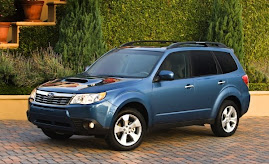
1st Place Subaru Forester 2.5X Premium Exorcized of cramped rear legroom and graceless styling, the Subie's charm becomes hard to resist.
2nd Place Nissan Rogue SL The 'ute for the PlayStation generation. Fun and affordable-but bring a kidney belt.
3rd Place Honda CR-V EX Quality construction and a handsome interior don't trump a busy ride and soupy handling.
4th Place Saturn VUE Green LinePrice premium isn't erased by its tax credit and better mileage, but it's fun to poke OPEC in the eye, isn't it?
5th Place Toyota RAV4 College-entrance committees are looking for more than solid SATs these days. You need a compelling story, too.
1st Place Subaru Forester 2.5X Premium Exorcized of cramped rear legroom and graceless styling, the Subie's charm becomes hard to resist.
2nd Place Nissan Rogue SL The 'ute for the PlayStation generation. Fun and affordable-but bring a kidney belt.
3rd Place Honda CR-V EX Quality construction and a handsome interior don't trump a busy ride and soupy handling.
4th Place Saturn VUE Green LinePrice premium isn't erased by its tax credit and better mileage, but it's fun to poke OPEC in the eye, isn't it?
5th Place Toyota RAV4 College-entrance committees are looking for more than solid SATs these days. You need a compelling story, too.
Thursday, May 8, 2008
Volkswagen Summer Finance Special

Subscribe to:
Posts (Atom)





_(544x408).jpg)


